
Research
Heart & Lung Diseases and Stem Cell Biology
Appointments
Associate Professor, Anesthesiology & Perioperative Medicine, Broad Stem Cell Research Center
Biography
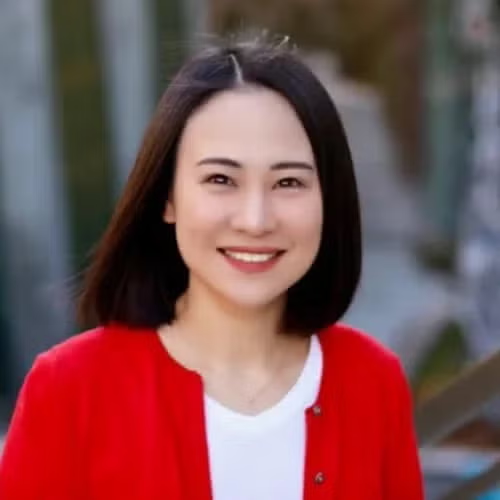
Mingxia Gu, MD, PhD, investigates how blood vessels contribute to organ development, disease and regeneration. By leveraging patient-specific stem cell models and advanced bioengineering techniques, she seeks to develop novel, personalized therapies for vascular and cardiopulmonary diseases, including congenital heart and lung defects.
For nearly all children born with a structural heart or lung disease, surgery is the only available therapy. Gu’s research aims to expand therapeutic options by developing new therapies and regenerative approaches that could be administered earlier — before birth.
The vasculature is a dynamic and specialized network essential for organ function, possessing significant plasticity and regenerative potential. Gu investigates how blood vessels influence tissue development, disease progression and healing, with the goal of developing new therapies for vascular-related diseases and advancing organ-regeneration strategies.
A central focus of this research involves generating patient-specific induced pluripotent stem cell-, or iPSC-, derived endothelial and smooth muscle cells, as well as vascularized organoids, to create more accurate disease models. By comparing these iPSC-based models with patient-derived vascular lesion samples, Gu has identified disease-specific cellular changes and mapped transcriptomic and epigenomic alterations at single-cell resolution. Recent efforts have focused on engineering vascularized heart, lung and brain organoids to explore how blood vessels interact with surrounding cells during development and disease.
In addition to illuminating disease mechanisms, Gu leverages a high-throughput drug screening platform paired with machine learning algorithms to identify compounds that can reverse disease pathology in a personalized manner. She is also investigating the signaling pathways that direct tissue-specific endothelial cell fate — the process by which vascular cells take on specialized functions — with the goal of regenerating blood vessel networks in congenital heart and lung defects.
Through a multidisciplinary approach that integrates bioengineering, synthetic biology, stem cell biology and computational modeling, Gu’s research insights could drive advances in vascular medicine and regenerative therapies.
Publications
- Gu, M, Choi, YS, Sok, S. Analysis of Characteristics Associated With Advanced-Stage Pressure Injury Classification Among Korean Hospitalised Patients: A Secondary Data Analysis. Nurs Open. 2026;13 (7):e70690. doi: 10.1002/nop2.70690. PubMed PMID:42447083 .
- Weng, T, Lamon, S, Gan, Z, Gu, M, Zhang, Q. Ultrabright Upconversion in Thermally Crystallized BaYF5:Yb,Er Glass-Ceramics via Dopant Enrichment for Reconfigurable Optical Data Encoding and Logic Operations. ACS Appl Mater Interfaces. 2026; :. doi: 10.1021/acsami.6c11783. PubMed PMID:42446948 .
- Wen, F, He, L, Zhu, S, Cheng, G, An, J, Meng, W et al.. Genome-wide analysis and expression profiling of the phenylalanine ammonia-lyase gene family in Chrysanthemum morifolium. BMC Plant Biol. 2026; :. doi: 10.1186/s12870-026-09513-7. PubMed PMID:42443765 .
- Miao, J, Chen, Y, Hang, Z, Feng, D, Han, Q, Zheng, M et al.. Syk from M1 macrophage exosomes drives vascular injury in kidney transplant rejection. Transpl Immunol. 2026; :102416. doi: 10.1016/j.trim.2026.102416. PubMed PMID:42442616 .
- Zhu, Q, Wang, J, Wei, Y, Liu, W, Shen, L, Fankhauser, CD et al.. Preliminary feasibility of SHURUI single-port robot-assisted radical cystectomy with exploratory comparison to a contemporaneous da Vinci Xi single-port cohort. Minerva Urol Nephrol. 2026;78 (3):383-388. doi: 10.23736/S2724-6051.26.06898-9. PubMed PMID:42438984 .